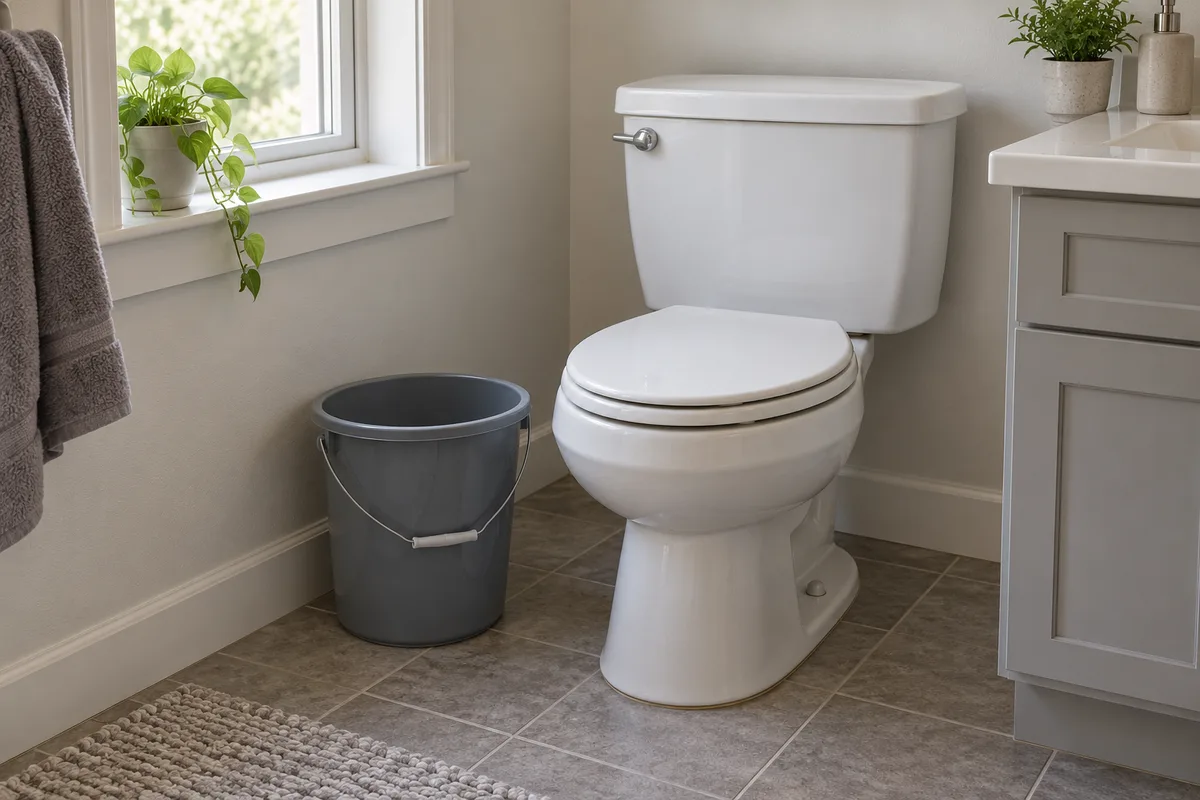
The lights go out, the refrigerator goes quiet, and then a much less glamorous question arrives: can you still use the bathroom? The useful answer is not simply yes or no. It depends on the toilet, the water coming into your home, and the route wastewater takes after it leaves the bowl.
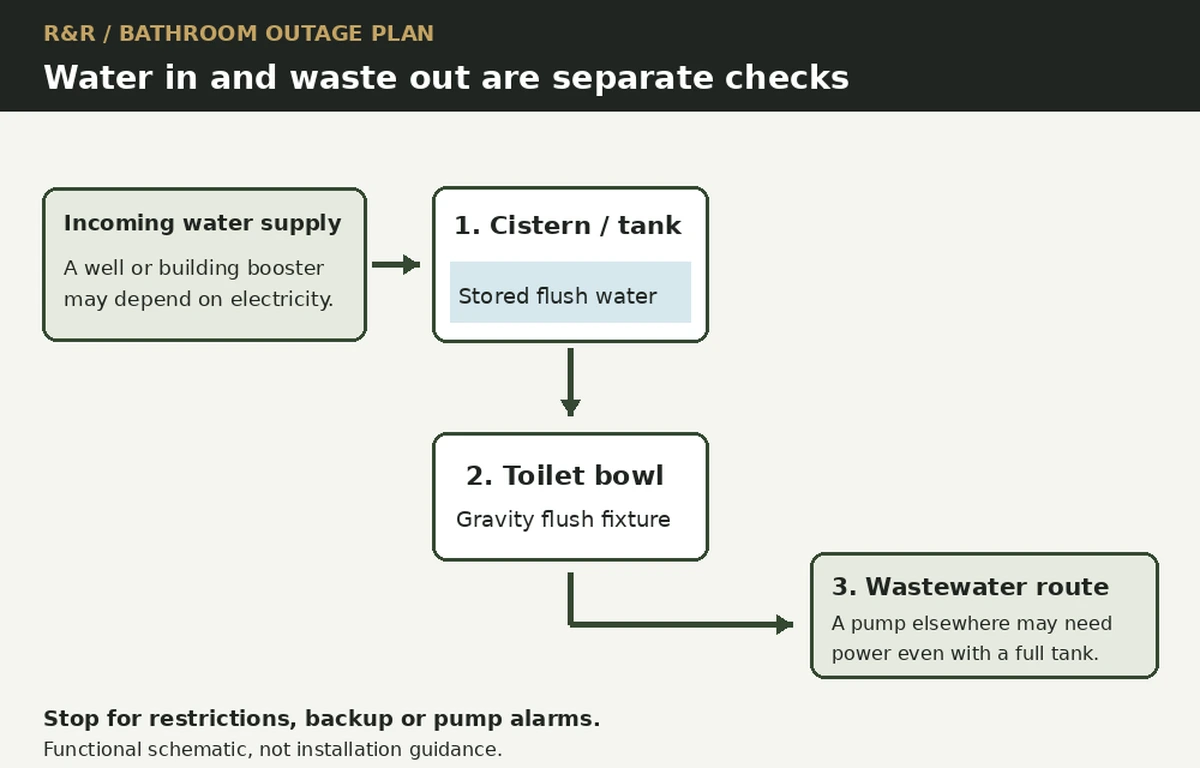
For an ordinary gravity-flush toilet, the flush itself does not need electricity. But a well pump, building booster, sewage ejector or pumped septic system may. You also need to follow any local restriction on wastewater use. A full tank proves that water is available for a flush; it does not prove the sewer can safely receive it.
Quick answer: check three things before flushing
You can usually flush a conventional gravity toilet during a power outage when the water supply continues and the wastewater system is functioning. Stop if officials restrict sewer use, a wastewater alarm sounds, sewage backs up, or an essential pump is without power. If the tank will not refill but drainage is confirmed usable, see our manual-flushing guide. If drainage is unavailable, use an emergency toilet plan instead.
Your three-check bathroom decision path
- Is there a no-flush instruction, sewage backup, rising bowl or wastewater-pump alarm? Stop using the toilet and obtain the responsible authority's instruction.
- Is the toilet or wastewater route electrically dependent, or is the system unknown? Confirm operation with the maintainer or building manager. A full cistern is not confirmation.
- Is this a suitable gravity toilet with usable drainage and no restriction? With available supply, normal use may continue. If supply is missing, review manual flushing. If drainage is unavailable, follow the no-flush planning guide.
Print the one-page bathroom household plan and fill in your actual system, current instruction and fallback. It contains no product links.
A power outage toilet decision table
| Your situation | What it means | Your next step |
|---|---|---|
| Gravity toilet, working municipal supply, no wastewater restriction | The toilet mechanism can work without household electricity | Follow local guidance and watch for changes |
| Gravity toilet, tank empty, confirmed working drain | Incoming water is the missing part | Review manual flushing and protect drinking water |
| Well pump or building booster has stopped | Pressure or refill may be limited | Ask the owner or manager about the supply arrangement |
| Ejector, grinder or macerator needs electricity | Waste movement may depend on an unavailable pump | Do not add wastewater; consult the system instructions |
| Pumped septic system, alarm, flood damage or sewer restriction | A flush may add to a system that cannot accept waste | Use a confirmed working alternative and obtain guidance |
| System type unknown | You do not yet have enough information | Check records or contact management before assuming |
Why an ordinary gravity toilet can work without power
In a conventional tank toilet, releasing stored water initiates the flush. That basic operation does not require an electrical outlet. Haller's plumbing explanation distinguishes gravity toilets from fixtures that depend on electrically powered waste removal. This is why a neighborhood blackout does not automatically disable every toilet in the neighborhood.
Start by identifying the actual fixture rather than relying on its appearance alone. A bathroom can contain a conventional-looking toilet while wastewater elsewhere in the house depends on a pump. A basement installation deserves particular attention because its discharge arrangement may differ from the upstairs bathroom. Look for the model information and ask the person responsible for maintaining the property.
Do not create a power failure to test the answer. Repeated flushing with equipment switched off is not a safe way to establish reserve capacity. Record what the manual or qualified maintainer says under normal conditions. If the information is missing, write “not confirmed” on your household plan. That small admission is more useful than a confident guess copied from a generic online guide.
Municipal water does not mean unlimited water
Benjamin Franklin Plumbing explains that municipal supply can continue while some private wells and building pumping arrangements lose their electrical support. Your utility's actual notice matters more than the assumption that city water always works. Supply and wastewater services may also issue different instructions.
Check the drinking-water utility and wastewater authority separately if they are different organizations. Save both contact routes. A statement that drinking water remains available is not automatically permission to discharge unlimited wastewater, and a sewer advisory may apply even while the tap runs. Keep the original notice or its link so household members are reading the same information.
Well water: the pump matters more than the flush handle
If water reaches your home through an electric well pump, the toilet's lack of an electrical cord does not settle the question. The supply may be interrupted when the pump stops. Any remaining supply depends on your particular setup, not a universal number of flushes. The plumbing provider linked above identifies the water-source dependency; your equipment documentation should resolve the details.
Keep the well service contact with your outage papers. Useful questions include whether the supply has an approved backup arrangement, what instructions apply during an outage, and what needs checking before normal operation resumes. Do not open electrical equipment or make a generator connection because a toilet guide suggested it. Those decisions require the actual equipment and a qualified installer.
For a household plan, separate “water available now” from “water we expect later.” Stored drinking water is a real reserve. A proposed generator purchase, an untested connection or a neighbor's offer is a different category. This distinction helps you choose a practical bathroom fallback without promising that the well will recover on a particular schedule.
Apartments and high-rises: ask about building systems
An apartment's water pressure and drainage arrangements may involve shared equipment outside your unit. The plumbing provider's outage overview notes the possible dependence on building pumps. That does not mean every apartment loses water immediately. It means the answer belongs to the building's actual system and procedures.
Ask management which notices residents should monitor, whether wastewater use is restricted during an outage, and what temporary facilities are available if toilets cannot be used. Request the normal after-hours contact route. Avoid asking for access to plant rooms or trying to interpret an unfamiliar control panel yourself. Your task as a resident is to understand the instruction that applies to your unit.
Store the answer with your apartment power outage checklist. Include assistance needs, stairs and access arrangements if you may need to reach another toilet. A portable option in the apartment is only useful when it is accessible, hygienic and supported by a waste-handling plan. A shared hallway or balcony should not be assumed to be an approved storage area.
Pumped wastewater and septic systems need their own plan
A sewage ejector, macerating fixture or pumped septic component introduces a different dependency: moving waste after the flush. Adding a bucket of water cannot restore an unpowered wastewater pump. King County's septic outage guidance warns that normal water use can produce backups when electrically dependent septic components are unavailable.
For homes with septic systems, obtain the system record and maintenance instructions before an outage. EPA's septic questions page explains how local permitting authorities can help locate design records and appropriate professionals. Use those records to identify the system; do not lift tank lids or inspect confined spaces as a household preparedness exercise.
Write the maintainer's contact and the location of the instructions on your plan. Ask what household members should do when an alarm sounds and who should confirm operation after power returns. This article does not supply breaker-reset or pump-timing instructions because those actions depend on the specific installation. A correctly identified contact is a better backup than a guessed electrical procedure.
How many times can you flush a toilet without power?
There is no reliable universal count. With continuing supply and functioning gravity drainage, the household power outage may not impose a fixed flush limit. With an interrupted supply, a filled conventional tank may provide a remaining flush. With an unpowered wastewater pump or a restriction, even that water should not be treated as permission to flush.
When manual flushing is the right next question
Manual flushing addresses a shortage of incoming water for a conventional toilet. It is not a repair for a blocked drain, flood-damaged system or failed ejector. Seattle Public Utilities' planned-water-outage guidance describes using stored water to flush during a supply interruption. Apply that idea only where drainage is usable and the fixture is suitable.
Our guide to flushing without running water separates the tank method from a direct bowl pour and explains stop conditions. Read it before carrying a bucket into a dark bathroom. If a household member cannot handle a water container comfortably, choose another arrangement instead of making that person lift a heavier bucket.
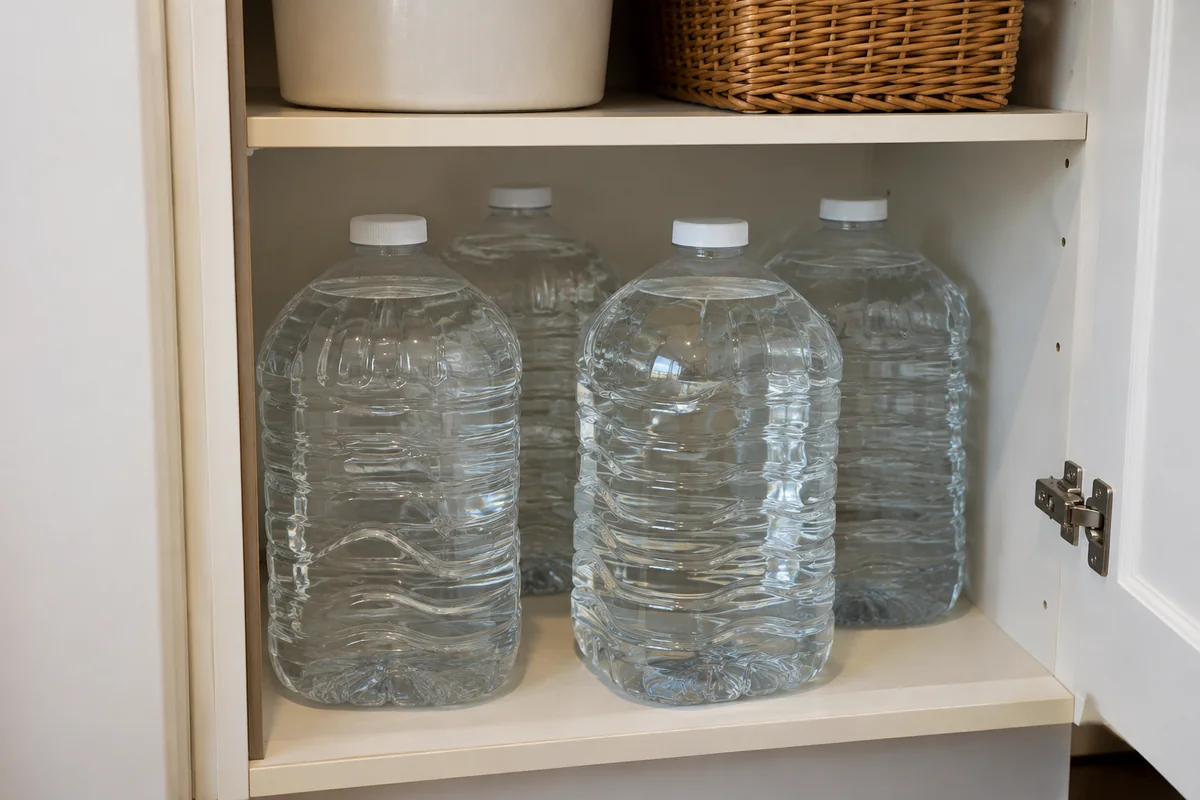
Keep drinking-water containers apart from the bathroom bucket. For reserve planning, use our small-apartment emergency water guide. A bathroom workaround should not quietly consume the whole household's drinking supply. Decide what water is available for each task and what you will do if the supply cannot support continued use.
A practical plan for the first hour
First, make the bathroom accessible with battery lighting. Then check current local notices and any building instruction. Identify whether the uncertainty concerns incoming water, wastewater removal or both. Ask household members to avoid repeated test flushes while you establish the answer. The goal is to gather information, not to manufacture evidence by using up water.
Next, choose a current bathroom option: normal use where permitted, manual flushing where appropriate, or a confirmed functioning alternative. Put the instruction in ordinary language. “Use the upstairs bathroom only, following the maintainer's plan” is useful if that is the verified instruction. “Be careful with plumbing” leaves everyone to make a different guess.
Finally, assign the next information check to one person and record the source. If you live alone, keep the contact and fallback destination on the same sheet. A friend, shelter or other facility is only a useful option if it is actually available and reachable. Do not assume a business remains open because it normally operates at that hour.
Emergency sanitation without turning it into a shopping spree
When flushing is unavailable, look first for a safe, functioning toilet you can use. North Carolina's emergency toilet guidance includes using another working toilet and describes temporary collection options. Your household's choice should consider mobility, privacy, hand hygiene and local waste instructions, not just the smallest product in an online listing.
Our apartment emergency toilet guide covers the planning decisions. Before buying anything, list what the intended users need and what disposal arrangements are known. A seat, bucket or sealed bag is one component. It does not establish an approved waste collection service, a safe place to keep waste or a way for someone with limited mobility to use it.
Keep the plan simple enough to explain to another household member. Record the kit location, the hygiene supplies and the authority to contact for waste guidance. If you cannot maintain sanitation safely, that is a reason to seek assistance or a suitable alternative location. It is not a challenge to improvise increasingly elaborate arrangements indoors.
If wastewater has already appeared inside the property, use our sewage backup in basement first-response guide for the incident checklist, call script and temporary bathroom decisions. Do not treat a backup as a reason to test another flush.
After electricity returns, check the system separately
The return of lighting is encouraging, but it is not proof that every pump and wastewater service has resumed. King County advises checking electrically dependent septic components after an outage. Follow your property's actual restart instructions and the current utility notice; do not copy another home's pump settings.
Use the household record to close open questions. Has the restriction been lifted? Has management confirmed the building arrangement? Did an alarm require service? Keep any follow-up separate from routine replenishment. Replacing used batteries and confirming a septic fault are different tasks with different people responsible.
Review what confused the household while the details are fresh. Perhaps the contact number was missing, the flashlight had moved or nobody knew which bathroom used a pump. Correct that small gap in the plan. The benefit of this review is clarity for next time, not a claim that your home has become immune to outages.
Your bathroom outage checklist
- Identify the toilet type and any electrically dependent wastewater equipment.
- Save water utility, wastewater authority and building-management contacts.
- Keep suitable battery lighting easy to find.
- Know where current restrictions are published.
- Keep drinking water separate from utility-water containers.
- Arrange a usable alternative if flushing is unavailable.
- Plan hand hygiene and waste handling for that alternative.
- Follow system-specific guidance before resuming normal use.
Download the bathroom outage decision sheet for your household notes. It leaves space for real contacts and confirmed instructions rather than supplying a guessed flush count. You can also browse our free preparedness checklists for the wider household plan.
Frequently asked questions
Can I flush if the toilet tank is full?
A full tank supplies water, but it does not confirm safe drainage. Check restrictions, pump dependencies and any signs of backup first. Do not use the tank as a test of a system you already suspect is unavailable.
Does a smart toilet always stop working?
Check the exact manufacturer's manual. Powered features and the basic flush can have different dependencies. The presence of a plug or electronic panel alone does not establish whether that particular fixture has a supported manual operation.
Can I pour water into an upflush toilet?
Adding water does not power its waste-removal equipment. Follow the fixture and pump instructions; do not treat an ordinary gravity-toilet method as a workaround for an unpowered macerator or ejector.
Is a blackout the same as a water outage?
No. They can occur together, but household electricity, incoming water and wastewater removal are separate services. Check which one has actually failed before choosing a bathroom response.